Whole House Water Filter for Well Water: Complete Guide to the Best Systems for SC Homes
By Dubya Water | July 08, 2026 | 10 min read
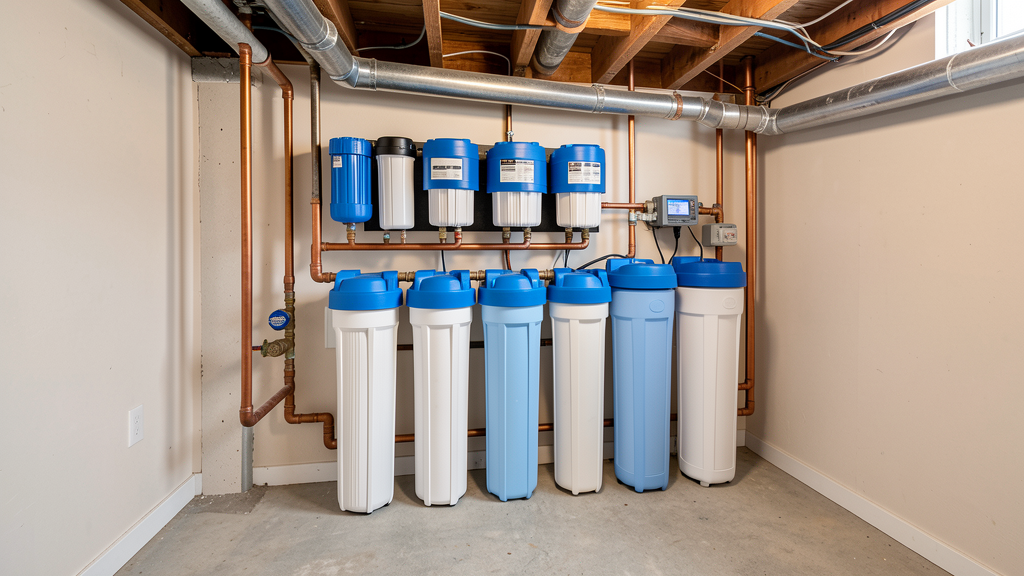
The best whole house water filter for well water transforms everything about living with a private well — no more rust stains on laundry, no more rotten egg smell from the shower, no more worrying about what's actually in the water your family drinks. But with hundreds of filter systems on the market, choosing the right one for your specific South Carolina well water chemistry can feel overwhelming.
This guide breaks down every type of whole house water filtration system, what each one treats, and exactly how to pick the right combination for your home. We serve homeowners across the SC Midlands, including Orangeburg, Rowesville, Cordova, and over 30 other communities within 50 miles.
What Does a Whole House Water Filter Do for Well Water?
A whole house water filter treats every drop of water entering your home — not just the water at one sink. It installs at the main water line, typically after the pressure tank, and filters water before it reaches your plumbing, water heater, and all fixtures.
This is fundamentally different from under-sink filters (which treat only one tap) or refrigerator filters (which treat only the ice maker). A whole house system protects your entire home.
What Whole House Filters Remove from Well Water
- Sediment: Sand, silt, and rust particles that clog faucets and damage appliances
- Iron: Causes orange/brown staining on laundry, fixtures, and driveways
- Hardness minerals: Calcium and magnesium that create scale in pipes and water heaters
- Sulfur (hydrogen sulfide): That unmistakable rotten egg smell that makes water unpleasant
- Chlorine/chloramines: Municipal well supplements that affect taste and smell
- Bacteria and cysts: Coliform bacteria, giardia, and cryptosporidium that can cause illness
- Tannins: Organic compounds that give water a tea-like color, common in low-lying SC areas
The 4 Main Types of Whole House Water Filters for Well Water
1. Sediment Filters — The Essential First Stage
Best for: Every well water home. Sediment is present in virtually all wells.
- How it works: Water passes through a spun polypropylene or pleated filter that physically traps particles. Micron ratings from 100 (coarse) down to 1 (fine).
- Typical setup: 20-inch or 4.5-inch big blue housing with replaceable cartridge
- Cost: $150-$400 for housing + $15-$40 per replacement cartridge
- Maintenance: Replace cartridge every 3-6 months
- SC relevance: Shallow wells in Bowman, Branchville, and areas along the Edisto River often have heavy sediment loads
2. Iron Filters — For Orange/Brown Water and Staining
Best for: SC homes with iron levels above 0.3 ppm (most of the Midlands)
- How it works: Oxidizing media (Birm, Katalox Light, or Greensand) converts dissolved ferrous iron into solid particles that get filtered out
- Typical setup: Backwashing tank with media + control valve
- Cost: $1,500-$3,500 installed
- Maintenance: Annual media inspection; backwash frequency depends on iron levels
- SC relevance: Iron is the #1 well water complaint in Orangeburg County. Orangeburg homes frequently test 2-8 ppm iron
3. Water Softeners — For Hard Water Scale and Mineral Buildup
Best for: SC homes with hardness above 3 GPG (most of the state)
- How it works: Ion exchange resin beads swap calcium and magnesium for sodium or potassium
- Typical setup: Resin tank + brine tank + control valve
- Cost: $800-$2,500 installed
- Maintenance: Add salt monthly; resin lasts 10-15 years
- SC relevance: Hardness levels in Elloree, Denmark, and Bamberg typically range 7-15 GPG
4. Carbon Filters — For Taste, Odor, and Chemical Removal
Best for: Homes with taste/odor issues, sulfur smell, or chemical concerns
- How it works: Activated carbon adsorbs chlorine, VOCs, pesticides, and odor-causing compounds
- Typical setup: Granular activated carbon (GAC) tank or catalytic carbon for sulfur
- Cost: $600-$2,000 installed
- Maintenance: Replace carbon media every 3-5 years
- SC relevance: Many wells in Cope and Norway have hydrogen sulfide gas that carbon filtration effectively removes
Multi-Stage Systems: The Complete Solution for SC Well Water
No single filter handles everything. The best whole house water filter for well water in South Carolina is almost always a multi-stage system customized to your specific water chemistry. Here's the most common configuration for SC homes:
Recommended: 3-Stage Whole House System for SC Well Water
- Stage 1 — Sediment Pre-Filter: 20-micron spun polypropylene cartridge removes sand, silt, and rust. Protects downstream equipment.
- Stage 2 — Iron Filter or Water Softener: Depends on your water test. If iron > 0.3 ppm, an iron filter comes first. If hardness > 3 GPG and iron < 0.3 ppm, a softener comes first.
- Stage 3 — Carbon Final Polish: Granular activated carbon removes remaining taste, odor, and any chemical contaminants.
What to Look for in a Whole House Filter System
- Flow rate: At least 8-12 GPM for a typical 3-bedroom home. Match to your well pump's output.
- Backwashing capability: Iron filters and softeners need automatic backwash to self-clean.
- Bypass valve: Essential for maintenance without shutting off your whole water supply.
- Certification: NSF/ANSI Standard 42 (aesthetic) and 61 (structural) at minimum.
- Local support: A system is only as good as the local installer who services it. Dubya Water backs every installation with a 10-year warranty and local service.
Why Testing Comes First — Always
You cannot choose the right whole house water filter without knowing exactly what's in your well water. A professional lab test reveals:
- Hardness (GPG)
- Iron content and type (ferrous, ferric, bacterial)
- pH level (critical for selecting media)
- Manganese
- Hydrogen sulfide (sulfur)
- TDS (Total Dissolved Solids)
- Coliform bacteria
- Nitrates and nitrites
Get a free professional water test from Dubya Water — call 803-855-1055. We test for iron, hardness, pH, sulfur, sediment, bacteria, and more before recommending any equipment. Serving Rowesville, Orangeburg, Cordova, Bowman, Elloree, Branchville, Denmark, Bamberg, Cope, Norway, and the entire SC Midlands.
Frequently Asked Questions
How often do I need to change whole house filter cartridges?
Sediment pre-filters should be changed every 3-6 months, depending on your well's sediment load. Iron filter media lasts 5-10 years. Carbon media lasts 3-5 years. Softener resin lasts 10-15 years.
Can I install a whole house water filter myself?
Basic sediment filter housings are DIY-friendly for experienced homeowners. However, iron filters, softeners, and multi-stage systems require professional installation for proper sizing, backwash drainage, and pressure tank integration. Improper installation can void warranties and damage your well pump.
Will a whole house filter affect my water pressure?
Properly sized systems cause minimal pressure drop — typically 2-5 PSI. Undersized filters with micron ratings below 5 can restrict flow. Dubya Water sizes every system to your home's specific flow rate and well pump capacity.
Do I still need a reverse osmosis system with a whole house filter?
For drinking water, many homeowners add a reverse osmosis system at the kitchen sink after the whole house filter. The whole house system handles sediment, iron, and hardness, while the RO removes dissolved solids, lead, arsenic, and nitrates for the best drinking water quality.
What's the best whole house filter for sulfur smell?
Catalytic carbon filtration is the most effective treatment for hydrogen sulfide (rotten egg smell). For moderate sulfur levels (0.5-2 ppm), a backwashing catalytic carbon filter works well. Higher levels may require an aeration system or chlorine injection before carbon filtration.
Call 803-855-1055 for a Free Water Test & Estimate
Serving Rowesville, Orangeburg, Cordova, Bowman, Elloree, Branchville, Denmark, Bamberg, Cope, Norway, and all of the SC Midlands.